Library Tour: Kaimuki Public Library

Happy National Library Week!  This year, National Library Week runs from April 10 until April 16.  In honor of this week, we wish to continue highlighting our love of local libraries by continuing our Library Tour of Oʻahu.

Nestled conveniently off the Koko Head Avenue exit of H-1, Kaimukī Public Library is one of the largest public libraries on East Oʻahu, being designated with the title of regional library.

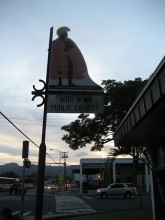
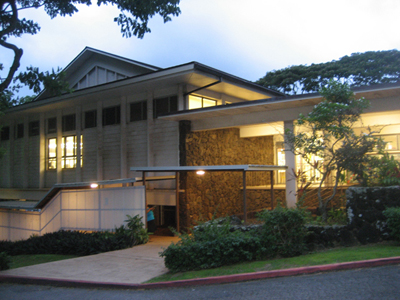
The front entrance of Kaimukī Public Library off of Koko Head Avenue. The parking entrance is found to the side, off of Harding Avenue.

The Building

The building was constructed in 1960, and was refurbished in the 1990’s to make it ADA compliant.  This is very apparent in the number of railed-off ramp areas to provide accessibility to this library on a slope. Reference Librarian Jeffrey Eldredge even joked about it being called “the skateboard library” due to its numerous ramps and inclines, perfect for skateboard tricks.

There are “two” parking lots—a lower lot to the immediate right with some covered parking under the library, and an upper lot which leads to the drive-thru book drop, “Friendship Garden,” and parking lot exit.  Sadly, like many libraries, this one suffers from a lack of ample parking spaces.  It’s such a big library with a great collection; it’s not a surprise that it’s so popular with residents in the vicinity.

On other hand, the drive-thru book drop is very handy for people who on the run who need to return their library books but don’t want to get out of their car.  Salt Lake-Moanalua Public Library has one of these drive-thru drops and I use it all the time to drop off books.  The advantage of Kaimukī’s book drop is that it’s automatically on the driver-side, so you don’t need to be on the wrong side of the road and/or bring a friend to drop off books while in the car.

Two convenient book drops found in the "upper" or "rear" parking lot of Kaimukī Public Library

One of the more notable design aspects of the library is the way it’s split up when you enter.  As you walk through the front doors, you’re immediately taken to a long circulation counter.  Basically, all the staff is immediately in this area, available for you to borrow books, drop off items, and ask for help.  After that, you’re forced to travel either to your left or to the right.  If you go to the right, this entire area is dedicated to the Children’s and YA collection.  There is a big green mat for storytime and play, rows and rows of low shelving for kids to peruse, and ample seating for kids and teenagers to relax, study, and enjoy the library’s ambiance.  On the left side of the library is everything else:  Internet terminals, CD and DVD collections, all the adult fiction and non-fiction books, magazines, microfilm, newspapers, and more.  There are tons of tables and carols to sit at; many are placed out in the center of the space, while others are hidden in various nooks and crannies for those who prefer a little more privacy.

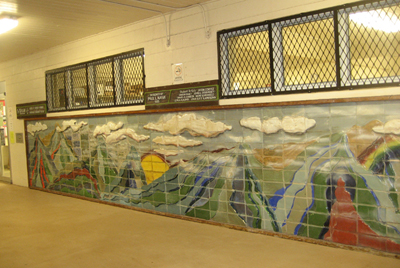
While the decor is relatively sparse, Kaimukī does its best to provide artwork in the form of children’s displays and crafts as well as a glass display case on the other side.  In this glass display case, the library will alternate between various historic, cultural and artistic displays.  For example, when we first visited Kaimukī they had an impressive display of Father Damien artwork from Honolulu Printmakers, while our most recent visit provided us with a collection of artifacts from Myanmar (Burma).  More notable than this are the immense murals which buffet the various inner walls of the library.  One of the most impressive of these is a thirty-six foot piece called “Bon Odori Hawaii” by Balazs Szabo, which consists of nine separate panels, steel-bolted together to form ‘seams’ reminiscent of a traditional Japanese screen1.

Kaimuki Public Library has an impressive collection of DVD's including a FilmMovement subscription.

The Collections

Size does not only matter for Kaimukī Library’s murals, but also for its massive collections.  Walking around the library, one of the most notable shelves are the DVD shelves lining one of the inner walls.  There are a ton of DVDs available to borrow (for the low, low price of $1), but what makes this branch special are their massive collection of foreign films and their Film Movement Collection.  For those of you who are curious, Film Movement is a company that provides a subscription service, offering one of the largest selections of award-winning independent and foreign films.  Chances are, if you’re a cinephile, you will love perusing the DVD shelves of Kaimukī.

In addition to their DVD collection, I feel like Kaimukī Library has one of the better collection of Hawaiiana books.  They have eight long shelves dedicated to Hawaii & the Pacific, many of which contain older books that are no longer published.  The last time I was there, I was nearly tempted to grab every single 1940-ish book I could find.  If I didn’t have so many books to read and wasn’t in a rush, I would have loved to hang out in Kaimukī and browse through their impressive collection of books.

Talking to the branch manager, Kaimukī Library also has a large collection of reapportionment maps and government documents, for those who are into that sort of thing; both the Honolulu Advertiser and Star-Bulletin newspapers on microfilm dating back to 1929; and Morningstar, Value Line, and Polk City Directories.  They also have the largest collection of Putumayo Music CD’s in the state library system, further providing evidence that Kaimukī Library is one of the most worldly of our public library branches.

Kaimukī has a nice collection of Hawaiiana, one that I'm eager to return to and peruse.

The Programs

Kaimukī offers a Sunday Storytime every week for keiki to listen to stories and make crafts.  This year, Sunday Storytime will last through July 31st, every Sunday at 10:30am except for holidays.  They also offer the usual series of special events throughout the year.  You may want to check out the Friends of the Library of Hawaii website for more event information.

For National Library Week, Kaimukī Public Library will be hosting the Music and Dance of Bali program on Tuesday April 19, starting at 6:00 p.m.  Performers I. Made Widana and Anna Reynolds will demonstrate traditional Balinese music and dance. The ensemble includes gongs, bronze metallophone instruments of various sizes, double-headed drums, and flutes. This one-hour program is suitable for all ages.

The Challenges

When we spoke with Reference Librarian Jeffrey Eldredge on the challenges that currently face Kaimukī Library, one of the first things he mentioned was the need for more computers for Internet access.  We’ve noticed, surprisingly, that in many of the libraries we visit, the computer terminals with Internet access are some of the most populated places to be.  I guess Misty and I often take for granted that we all have Internet in our homes.  Speaking of which, another issue that Mr. Eldredge would like to implement is to have wi-fi access in the library.  Currently, only two public libraries have this capability (Salt Lake-Moanalua and Kāneʻohe), but it’s a service that many of his library patrons often ask on a weekly basis.  Mr. Eldredge noted that Kaimukī Public Library is plugged in and “ready to go” if the opportunity should arise—with help from the Friends of Kaimukī Library, they’ve acquired enough furniture and set up laptop stations in the library to accommodate people with their own computers.
The Book Recommendation

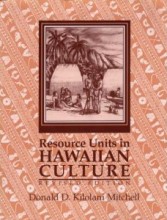
The book that Reference Librarian Jeffrey Eldredge recommended the most was a non-fiction book entitled, Resource Units in Hawaiian Culture by Donald D. Kiolani Mitchell.  This is a book that was published by Kamehameha Press in 1992 which Mr. Eldredge says includes everything from Hawaiian culture from fishing, hunting, food, crops and games. It’s the book that is recommended the most for use by children doing reports for school.  Jeffrey Eldredge is proud to admit that it’s “one of [his] favorite books.” 

[gn_divider]

We hope you enjoyed our foray to Kaimukī Public Library—a regional library which has some of the biggest collections in the State.  We want to thank Kaimukī Public Library and Jeffrey Eldredge for providing us the time and resources to let us talk about their great library branch.  They’re not uploaded yet, but be sure to check out our Facebook page for more photos of Kaimukī Public Library!

Reference:
1. Balazs Szabo: Soaring Now, Aloha, April 1984.

Library Tour: Mililani Public Library

This week, the Mililani Public Library is celebrating 26 years of service! In recognition of this we thought we’d catch up on our Library Tour posts and send something out about their branch. There will be all kinds of festivities going on throughout the week so if you find yourself in the area stop by and wish them a happy birthday! Check here for a schedule of events and more information.

The Building

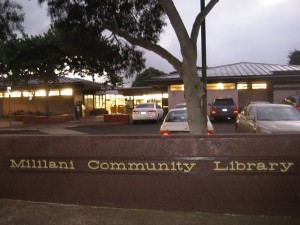
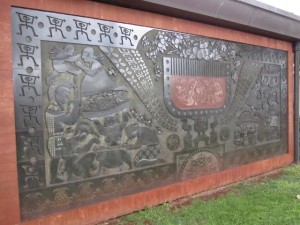
Built in 1984, the Mililani Public Library has been an important cornerstone to this growing suburban community. Situated across from Mililani High School and the Town Center, its location is easy to find and convenient. Parking is somewhat limited for a branch of this size, especially on Mondays which is one of their busiest days.  One of the most characteristic elements of this library are the stone carved murals on the left face of the building and right before the entrance. The building was designed to incorporate the outdoors inside and there’s lots of corner windows as well as a center atrium to let in natural light. The mix of stone and glass in this spacious one-story library is very unique. The red mortar and low, slanted roof makes it look like the building popped right out of one of the red hills.

As you walk in through the sliding doors there’s a hall way leading to the bathrooms and the silent reading room where the foreign language books and newspapers and magazines are kept. “The room is very popular and it’s nice for the older kids to have a quiet place to study… one patron uses the quiet room specifically to do her bills because it forces her to focus”, said acting Branch Manager Wendi Woodstrup as she gave us the tour.

Directly in front is the circulation desk and across from it catalog terminals, copy machines, community event boards and Friends of the Library books for sale.  The keiki section takes up the majority of the right half of the space with adorable kiddy study cubbies along the wall, ample floor space for story time, and puzzles.

Across the center area you can’t help but gaze outside at the atrium and notice all the indigenous Hawaiian plants. Just off the atrium are the internet terminals and Hawaiiana section.  We particularly liked how the Hawaiiana sections had plastic signs/markers sticking out from the stacks by subject so that you could quickly find “cookbooks” or “crafts”.  Next to the Hawaiiana shelf there are numerous study tables, a colorful bench in front of the manga section for teens, and the rest of non-fiction is organized on shelves positioned diagonally to maximize both space and flow; it’s a lot easier to browse the stacks by subject.

Programs and Challenges

Unfortunately, aside from story time and the occasional author event, it’s a challenge for the Mililani Library to offer other programs because they are so understaffed. Open six days a week and two nights, Mililani is a branch with one of the most operating hours to meet the needs of such a large community.

What is genuinely special about this branch is the way patrons are prioritized and space is allocated for everyone. They’ve clearly used the building to their advantage. The teens have their own space and a whole shelf dedicated to pamphlets and materials, not just on applying for college but paying for it as well—info on where to sign up for entrance exams or certifications and all manner of useful applications for them to take home and fill out, not just books.  The same goes for military families or voters… this branch really goes out of its way to make materials available with pamphlet stations and information on almost every shelf. Wendi said they try hard to be proactive, they know that they’re short-handed and often people have to wait to be helped, “It’s hard to get to people in a timely manner…but we want to make things as easy as possible to find”.

Because of its location and the centrality of Mililani in general, this branch has high traffic with a lot of people coming in daily, especially students and families. “It’s a very young community and they really value this library”, Wendi explained.

Book Recommendation

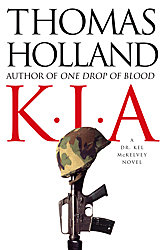
Thank you to Wendi and the staff at Mililani for taking the time to show us around and share a little bit about what they do.  Wendi’s book recommendation for us is a book by a local author and Mililani resident. KIA by Thomas Holland, who was the scientific director of the Department of Defense’s central identification laboratory here in Hawaii, is supposed to be a thrilling ride. Hopefully we’ll be able to read and review it for you soon!
For more information about the Mililani Public Library or any of the other branches on our tour, please visit the HSPLS website.

Library Tour: McCully-Moiliili Public Library

Earlier this week we mentioned that McCully-Moiliili Library will be hosting a mini-con (miniature Comic-Con) this weekend. If you haven’t seen the announcement, click here for more details. We thought we’d take this opportunity to catch up on our Library Tour and write-up a little something about this unique branch.

The Building

McCully-Moiliili is one of the oldest (41 years old this November) libraries in the HSPLS. Situated off of the perpetually busy South King Street, this branch was the first public library to have two stories and  is one of only two libraries that have covered parking.  Alex and I remarked at how McCully-Moiliili Public Library is fortunate to have the parking space that they do considering how very little of it there is to spare in the area, but Branch Manager Hillary Chang said that they’ve “nearly outgrown the lot” and find it to be a daily challenge, especially between the peak hours of 3 and 5 pm when they have the most traffic.  They do have “30 minute” parking stalls which is something you don’t see at every branch but understandable considering this library’s patronage.

As you walk into lobby the first thing you see are the usuals:  shelves with gently used books for sale sponsored by the Friends of the Library and community bulletin boards with posters and announcements for events . The entire first floor is dedicated to circulation and children’s books. It’s a fairly large area with a recessed floor space where the kids can spread out with books, puzzles or stuffed animals. It’s a carpeted play-pit that’s great for story-time because they can sit on the steps to listen. There are bears in hot air balloons  hanging from the ceiling that look adorable off of the  sky blue-painted walls and colorful round tables that beg to be sat upon. We particularly liked the way the books were organized, it’s very detailed, not just by age but by grade level and interest.

Immediately up the stairs or out from the elevator you see the research desk and internet terminals. They have a fair number of computers set up for internet use, but given the amount of people that come into this particular library, there’s usually a bit of queue. Magazines, DVD’s and CD’s are on the left side with adult non-fiction and fiction on the right. There’s also a sizeable Young Adult section to the rear of the second floor, separate from the boisterous keiki room so they can study or host programs without being bothered.

Special Programs

With the success of the keiki storytime  program (see the play-pit with great acoustics to the left) the McCully-Moiliili library staff wanted to do something special for neighborhood teens, an age group many librarians have told us are less likely to visit. McCully-Moiliili was one of the first to experiment with gaming night and other multi-media programs to engage teens. Games where they could compete and learn like “Guitar Hero or Dance Dance Revolution which the kids really enjoy” said Chang.
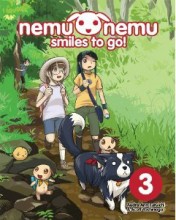
She also makes great efforts to host local author visits and feels it’s beneficial for teens and patrons to meet authors and listen to them speak about their books and about writing. Hosting people such as Dean James, Kelly Armstrong and Audra Furuichi, the creator of the popular Nemu*Nemu manga, Chang has had great success with her “Meet the author” programs even though “sometimes it’s hard because the authors are shy to speak”.

Unique Collection

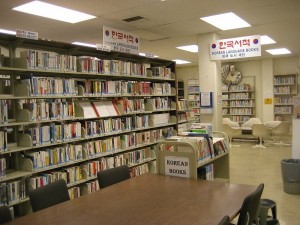
McCully library has one of the largest collections of Korean Dramas in DVD because they’re so popular with the neighborhood patrons. But it’s not just K-Drama and Korean language films, McCully has the largest selection of Korean language books as a result of funding from the Korean Library Foundation (the same way Liliha has the largest collection of Chinese language books). Getting the books wasn’t their biggest challenge, but cataloging them was. In the Korean language there’s no standard for Korean to English spelling which made searching for books difficult for patrons.  Hiring a Korean Language technician to catalog the books in every spelling that may be used has helped greatly and now the collection is very popular and widely used.

Another interesting aspect of McCully-Moiliili Library is the size and breadth of its graphic novel collection. Chang said she believes that graphic novels can be entertaining and educational for people of all ages, not just teens and young adults. It’s a publishing/media platform that’s been growing in popularity and Chang has been trying to build up a collection suitable for older audiences, so she “interfiles” them with the regular adult fiction.

With this local library’s belief and support of multimedia books like graphic novels, it’s no wonder they’re hosting a mini comic-con this weekend!

Challenges

When we asked about any challenges this location has to deal with Chang chuckled and said that budget constraints make it difficult to buy the latest books and they constantly try to “purchase responsibly—the ‘new books’ section is a bit empty but everyone is optimistic!”. She went on to say “what’s really unfortunate has been the rise in homeless encampments in the area. This is not a bad location and they never bother anyone, but it’s still an added challenge”.  Another challenge, that made me a bit sad, was the occasional theft of materials, specifically their graphic novel collection.  To combat this, Hillary cut holes in the cover to help deter would-be criminals from taking an obvious library copy home, and she says that the strategy has been working so far.

Conclusion

McCully-Moiliili Public Library is an important piece of the Hawaii State Library System due to their central location off of S. King Street, large collection of Korean materials, and the energy and passion of Hillary Chang’s devotion to young adult content.  We want to thank Hillary Chang for taking the time to sit with us and talk about her library branch and all of the staff for their patience with us.  Mahalo nui loa!

Book Recommendation

Given Hillary Chang’s love of anime and manga as evidenced by her participation in events such as Kawaii Con and organizing Mini-Con, it only made sense that she recommended as her book choice a comic creation by local Hawaii artists.  Audra Furuichi (who will be in attendance at Mini Con) and Scott Yoshinaga created the successful webcomic nemu*nemu, which happens to be a favorite at Hawaii Book Blog.  These comics are regularly compiled into soft-cover books with additional features to incentivize their purchase.  Being a big fan of the series herself, Hillary not only recommended but walked us over to the section to excitedly give us the books herself.  In fact, because of her strong support for these arts, Hillary Chang was even mentioned in nemu*nemu volume 3 in the closing thanks.  The versions we had the pleasure to read were nemu*nemu volume 1 and volume 3.  Look for a review of these books in the near future at Hawaii Book Blog!

Mahalo—and don’t forget to attend Mini Con tomorrow, Saturday October 23 from 10am to 1pm!

Library Tour: Salt Lake-Moanalua Public Library

National Library Week is coming to a close and hopefully you’ve enjoyed our visits to Waikiki-Kapahulu, Pearl City, Hawaii Kai, Wahiawa and Kalihi-Palama as much as we have. If you missed them, go check them out! This is our last library write up for a little while (don’t worry we’ll continue our library tour in a few weeks) and we thought we’d end with one of our favorites. Alex and I are both alumni of Moanalua High School (go Menes!) and had both spent many after-school hours at the Salt Lake Public Library reading or working on projects—quietly of course, because the security staff are very diligent. It hasn’t changed much and it’s still our ‘go-to’ library since it’s close to where we work and you can’t beat their drive-up book drop. Every time we go, we see the same man sitting at the reference desk answering questions, helping kids with the computers and just keeping everything in general order. It turns out that he’s  Branch Manager, Duane Wenzel and we had the privilege of chatting with him about his branch.

Salt Lake Moanalua Library

The Building

We were a bit shocked when Duane told us that the original “Salt Lake Library” started out as a storefront space in the neighboring Salt Lake Shopping Center. The building that exists now was built in 1992 and opened in August of the same year. What makes it unique is that it’s two stories and the HSPLS support offices are on the second floor—it’s basically command central. The Catalog department, IT department, Advertising and Marketing (Hi Paul!!) and Human Resources for the whole Hawaii State Public Library System are all there toiling away to make sure everything runs smoothly!

Windows at night

The parking lot is shared with Aliamanu Elementary, so it’s not unusual to see lots of kids milling around the entrance waiting for pick-ups or doing homework. Once inside, the circulation desk is to the right and to the left are the community bulletin boards and Friends of the Library books for sale. Looking straight ahead the first thing you see is a floor-to-ceiling set of windows looking out onto Salt Lake Boulevard. The main area is very grand and spacious, splitting the library into two halves. Although, this is the first library where the bigger area was for the kids. On the right there’s the Teen and YA books with a sizeable collection of teen magazines, manga and graphic novels. The keiki section is on the far side with some small tables and chairs, low shelves, and loads of carpet space to move around on during story times.

"Moanalua Memories" , murals in high places

The middle of the library is filled with tables and flanked on three sides by large murals on the high ceiling. The murals titled “Moanalua Memories” are a set of cultural/historical illustrations of the area and they’re simply gorgeous. Done by Patrick Ching in 1999 they were put up by the State Foundation on Culture and the Arts as part of the Art in Public Places Program. I can’t imagine these murals in any other library—they’re so well suited for Salt Lake’s high ceilings, wide open spaces and natural light from the massive windows. This atrium-like area has “great acoustics” according to Duane, and they often have Hawaii Theater for Youth and other musical presentations there because of that and the amount of space.

The adult fiction, nonfiction, media and Hawaiiana sections are all on the other side. We love how the shelves are arranged on a diagonal— it really makes the space feel larger and flow better. It’s less boxy and allows you to see almost every section of the library (yay for not losing Alex in the stacks—it happens a lot). The back wall is affectionately called the “Featured Fiction Wall” with staff picks and reading recommendations. They also have a ‘Quiet Room’ for study and silent reading where they keep their magazines and newspapers.

Book drop on 24 hour surveillance

The most useful feature of this library, and we wish all the libraries were able to have one, is the drive-thru book drop. It’s the best thing ever. Especially when you’re rushing to work and gotta turn in your books or else add another day of late fees to your tab, ahem, like we so often end up doing. There are cameras situated to record all activity in the parking lot and the area around the book drop, even a camera that can catch what you’re putting into the book drop (so no funny business). When we drive up, I like to pause for the camera to see what book I’m dropping in like the models on the Home Shopping Network. Alex thinks I’m silly.

Programs & Collection

As far back as I can remember visiting this library they’ve always made extraordinary efforts to create unique programs for kids and teens, especially in science and technology. They often have posters up for game nights, play time and experiments with bubbles and other great interactive activities. They have “Wacky Wednesdays” where they focus on YA programs when they can do more complicated crafts and projects like sewing felt animal charms. “They’re a difficult age group to reach… reading tends to fall away”. Keiki and teen programs are a great way to help kids “get a foothold in reading”.

Salt Lake Library employs the system’s only male children’s librarian, Kurt. He organizes “one of the best” story time programs on the island known for his creative use of music by playing guitar and singing. He also does shadow puppets and felt board plays in conjunction with the reading. Most importantly, his program is run continuously, year-round and if Kurt can’t be there he will make sure that someone else is. Consistency is especially crucial, Duane said “for young kids to start on the path to reading properly and creating good reading habits”.

Martial arts DVD display

Salt Lake is one of the only libraries to offer free Wi-Fi. Right now it’s just them and Kaneohe, but it’s something that’s very popular with patrons. Duane says they’ve had a lot of success with it and hope that other libraries will soon be able to participate. They have the second largest Korean language collection, but thanks to the Korean Library Foundation they will be expanding it to include more bestsellers.

As we walked around we noticed there seemed to be a lot of martial arts books, and the DVD section had a lot of martial arts titles…plus there were displays and posters up. We hadn’t really noticed it before and when we brought it up Duane chuckled and proudly explained that they have “the best martial arts section in the system… a special collection that nobody else has”. He says it circulates very well with about 1/3 of the materials always out. They get requests from other libraries constantly and are happy to share.

Martial arts books

“I’m a martial artist myself”, Duane told us. “I knew there were tons of DVD’s, books, and videos out there but when I looked for them in the system we had so little and Hawaii has a huge martial arts community. I knew there would be a draw.” So he saw a need and helped fill it. Not only that, but he helped the catalogers tag the books appropriately so that they can easily be found in the database. He creates the displays to draw an interest and let people know that they can find it all in one place in this library. They have both cinematic and instructional martial arts DVD’s, plus historical, cultural and instructional books on all disciplines, “every style imaginable”.

Challenges

They’d like to be a “community center of sorts” and know that people in the neighborhood would like them to be open on the weekends. Unfortunately, in order to do that they’d have to have a full staff and budget issues make that nearly impossible at this time. Especially now, Duane said he’s noticed an “increase in people coming in, circulation has gone up since the economy slowed down”. They have people come in to fill out online job applications and check out career books.  “We help a lot of people.”

They had some issues with graffiti and vandalism in the past but the 24-hour surveillance has really helped to curb that.

The lack of funds and the rising cost of materials is hurting the whole system, and despite that significant challenge the staff at Salt Lake Library are helping to save money and gain books in a very creative way. In 2009 they won the HSPLS Team of the Year Award for their work on The Children’s Science Book Project.

Each year, the Children’s Science Book Project Team sends letters to the top children’s publishers asking for complimentary review copies of their latest science trade books for children; reviews, rates, annotates and enters each book received; develops an annotated bibliography, arranged by subject, of all titles received that year and distributes 1,000 copies statewide in varying quantities to each public library.

You can read more about this project and their award here. Dedication and innovation can go a long way, the staff at Salt Lake Library know.

Book Recommendation

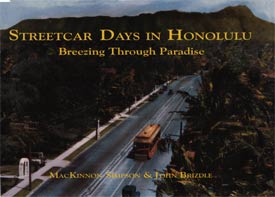
We asked Duane for a book rec and I gave my usual rant about needing to spread local literature and encourage local authors. I needn’t have been so dramatic because he completely agreed with me, and I didn’t know it yet, but I was ranting to a Hawaiiana expert—how embarassing! It turns out Duane Wenzel was the head librarian at Bishop Museum for 12 years and knows full well without me telling him how unique our local literature is. Needless to say, we had a great conversation and he had many recommendations. He first suggested Hawaii Homefront by Mac Simpson, which we already reviewed here for Veteran’s Day.  Duane knows Mac personally since he used to work at the Maritime Center and would often visit Bishop Museum Library and archives for research. Duane ended up picking another book by Simpson, Streetcar Days in Honolulu which I was excited to read. Reviews are forthcoming!
Thank you so much to Duane and the rest of the Salt Lake staff for letting us visit, and for always patiently collecting our overdue fees without judging us.  🙁

Library Tour: Kalihi-Palama Public Library

I used to travel to Kalihi a lot as a kid.  My mom’s best friend lived there, in a snug shared house where I had a bunch of calabash cousins to play with.  So now, even though I’m usually driving through Kalihi instead of to it, I still have fond memories of the neighborhood and people.  I realize it’s more diverse than this, but I often associate Kalihi with my Filipino aunty, her kids, and things like popping crazy amounts of firecrackers until the streets were flooded with smoke on New Year’s Eve. Our favorite Zippy’s is also in the Kalihi-Palama area—the one on Dillingham by Palama Market.  Misty likens this Zippy’s to a quaint dollhouse, with its wooden painted beams and relatively low tables, windows and seating (she says it makes her feel like she’s a doll…eating wonton min).  These are all very homey and comfy, a feeling I was surprised to find again when we visited Kalihi-Palama Public Library.

Kalihi-Palama Public Library from H-1

Some libraries are slick and new like Waipahu and Kapolei; or take great pains at maintaining a clean and spacious area like Waikiki-Kapahulu; others are crammed with books and materials but organized impeccably like Liliha or Aiea; but overall they all have that overwhelming sense of being a library.  For Misty and I, Kalihi-Palama seemed different—when I was there, I actually felt like I was at an aunty’s house; an aunty that really likes to read and has a lot of books.  It felt like visiting a relative’s house where everything is cozy, relaxed, maybe a tad over-decorated but done with the utmost charm and personality.  That’s Kalihi-Palama: with one of the most adorable children’s sections in the entire library system.

The Building

We met with branch manager Marcia Nakama on one of the many tables clustered in the middle of the library—bordered by the adult section behind us and the children’s wing to our side.  First we talked about the library building and it is a classic…it’s been around for the last 60 years and is one of a number of library buildings designed by the famous modernist architect, Vladimir Ossipuff.  It’s location is both cause for celebration and concern.  Marcia states that because they are RIGHT off the freeway, they “miss people all the time.”  Driving up Kalihi Street right after the H-1 off-ramp, we nearly missed it and had to turn a quick hard-right into the parking lot.  On the other hand, Marcia says she does like being near Farrington High School and a number of others as they contribute greatly to the efforts of this particular library.  Kalihi-Palama Library is also one of the few libraries that has an auditorium available for rent.  We noticed that the auditorium has a separate entrance so that there is as little disturbance to library patrons as possible, especially since it’s rented out quite often.

Down the side hallway there are long shelves full of books for the Friends of Kalihi Library book sale.  Another thing we noted that contributes to the sense of ‘ohana in the community, was a Family Resource Center which had all kinds of flyers, brochures and applications to assist families.  Marcia says “it’s hard to keep it up [the Family Resource Center]” but they try their best to do so.  She says making the extra effort of putting pamphlets out on the common tables, and using colroful tablecloths goes a long way to encouraging their library patrons.  Speaking of which…

The cute keiki room

It is readily apparent that children are an important focal point here at Kalihi-Palama and this is evident in their wonderful kid’s section.  This space encompasses a large area padded with shelves of books and is cheerfully bathed in an assortment of colors and decorations including stuffed animals and knick-knacks on the top of shelves, kids drawings and crafts on display or hanging from the walls, and delightful round tables covered with pretty tablecloths and flower vases.  When we say Kalihi-Palama is homelike, we are primarily referring to the children’s wing.  Misty was very tickled by the decorated tables and said she would like to have tea there—this is one of the most charming spaces we’ve encountered on our library tour.  I’d recommend any parent to bring their child here (especially little girls) to experience its delectable atmosphere .  Marcia says it’s “even appealing to adults,” and going by our reactions, this is definitely true.

Collections

Marcia was quick to note that Kalihi-Palama has a very large Korean Drama section.  Korean television drama is a whole ‘nother beast that has recently taken off here in the past 5-10 years—you can’t go anywhere without somebody raving about watching it.  Marcia adds on that Kalihi-Palama, McCully-Moiliili and Kapolei Library are often the first libraries to acquire these DVDs as soon as they are released.  Just scanning the shelves, we took note that in addition to K-Dramas they appear to have a nice collection of DVDs in general and also a lot of audio books.

The Teenager's Loft

Continuing with the theme of ‘aunty’s house’—I like to think that aunty has a teenager (or two…or four) upstairs doing their own thing, this library happens to have a cool loft area up on the second floor. I say this because as soon as I walked up the narrow stairs, I was confronted with a bunch of teenagers hanging out in this secluded space.  Good or bad, I notice that libraries that have an isolated Young Adult (YA) section will always have a group of teenagers loitering about.  We’re glad they’re in the library! All of the teen fiction is found in this loft area, including all of the manga and graphic novels.  It’s kind of like each family member has a room here at Kalihi-Palama.  The kids have a cute space all to themselves; the adults take up the big, generic living room; and the teenager(s) hang out separately from everyone else in their loft.  At any rate, Marcia mentions that their YA materials get high circulation and I believe that in addition the library’s proximity to Farrington, the “cool hangout” vibe of it’s upstairs loft helps contribute to this.

Programs

Sadly they had to cut a lot of programs from their roster due to the budgetary restrictions that have been plaguing the library system. They used to have a monthly program for teens but had to let that go and instead try to encourage them to volunteer as helpers for their popular keiki craft programs. In fact, many of their programs are completely run by volunteers, primarily students from Farrington High School.

One of the bread and butter programs for Kalihi-Palama is their Storytime and Craft Time activities.  Brenda Freitas-Obregon does a lot of the storytime readings and is very “well known” in storytelling circles.  “Lots of people will come from all over [the island] for this storytime,” Marcia proudly remarked.  One of the most remarkable aspects of this storytime is that it is continuous throughout the year.  Other libraries—often due to funding and staffing shortages—are only able to offer storytime on a revolving basis, maybe 3 months straight followed by a few months hiatus.  But Kalihi-Palama Library is lucky to have a dedicated storyteller like Brenda on hand.  “[She] never takes a hiatus [from storytime].  She only doesn’t do it if she is out of town.”  This is maybe twice a year tops, Marcia notes.  Also, local children’s author Gail Omoto (see below) is actually one of Brenda’s regular “storytime mommy’s.”

Challenges

Like most libraries, their biggest challenges revolve around funding and staffing.  Marcia mentions that they are short-staffed and this is their primary concern for the time being.  They also used to do passports, like a number of libraries, but also had to lose the program due to staffing problems.  Processing passport applications is not only beneficial to the community—Marcia notes that the Kalihi-Palama area has a lot of immigrants who eventually become citizens—but is also beneficial to the library as it provides supplemental income which in turn can be used to provide for extra books, supplies, furniture and materials.

On a lesser note, sometimes parking can be limited when the library is open.  I think we got lucky when we came, something in the auditorium was just starting to bring more cars to the lot, but we snagged one at the last second. Marcia reassures us, however, that even if there’s something going on in the auditorium,  library “patrons get first priority” when it comes to parking.

Book Recommendation

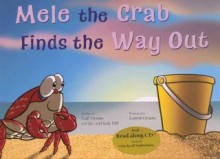
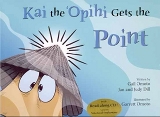
Seeing as Gail Omoto is a regular visitor at Kalihi-Palama Public Library, Marcia thought it would be appropriate to recommend one of the children’s books she has written.  We actually reviewed one of Gail’s books already, Kai the ‘Opihi Gets the Point, as the librarian from Waimanalo School & Public Library had so enthusiastically recommended it.  However, Ms. Omoto has another popular keiki book, Mele the Crab Finds the Way Out, and we happily agreed to read and review it.
Much mahalos to Marcia Nakama and her staff at the Kalihi-Palama Public Library for letting us into their endearing library!  Don’t forget to continue checking in with Hawaii Book Blog as our week-long celebration of National Library Week continues with one more library post tomorrow.

Library Tour: Wahiawa Public Library

Wahiawa is an interesting place, a small cross-roads community tucked between Mililani and North Shore, and neighboring one of the largest US Army Installations  in the West. It’s kind of a two-street-town with the majority of its stores and eateries off of California Road. They look like they’ve been there forever. I’ll have to admit, Alex and I don’t spend much time there but we were happy to visit the library and get to know the area a bit.
 

The Building

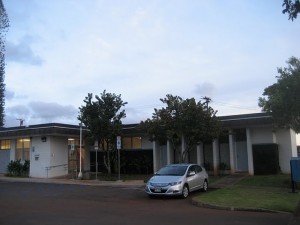
My dad always used to tell me that “dynamite comes in small packages”. Wahiawa Public Library may look a bit small on the outside but it’s music collection and selection of popular fiction is nothing to scoff at. I think the library matches the town perfectly and acting Branch Manager Anthony Hooper would agree.  We met him at the children’s reference desk and asked about the library’s history.

The current building has been in place since about 1965. Prior to that, the community library was located up the street and shared quarters with the Department of Education. The lot the library is on now was once a hotel and then later a school site. It’s been renovated several times and unfortunately is still the same size. Budget only ever allowed for refurbishments and not additional square footage despite the population growth. Mostly for things like replacing windows, retrofitting the lights and repairing damages due to vandalism and break-ins.
Coming into the library from the parking lot you walk through a long hallway with bulletin boards littered with posters and announcements for Wahiawa events and library news. There was a big section of the board dedicated to job announcements and career opportunities which we were glad to see available.  The hallway opens up into the main room and you can see the front (street) entrance where the Friends of the Library have set up an area for their ongoing mini booksale.


The keiki section takes up about half of the overall space and tall blue bookshelves cover the walls. It’s neat and organized–packed with books, definitely making use of all available space. I was drawn to their sizeable fairytale collection, one of the biggest I’ve seen outside the State Library. There’s carpet space for the kids but unfortunately not a lot of tables or seating areas.

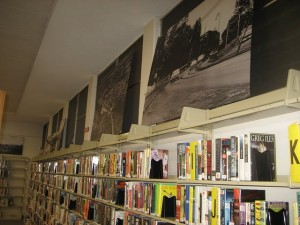
On the other side of the circulation desk is the adult fiction, nonfiction and reference areas. We were surprised to find that their Hawaiiana collection is pretty big despite the obvious space restrictions. What we enjoyed most about that side of the library were the large print, black and white photographs of old Wahiawa that are displayed all around. Looking up at the pictures you can’t help but notice the security screens on all the windows. “It looks like a jailhouse” Hooper joked, but  said sadly that break-in attempts are a consistent problem they’ve had to deal with.

Programs and Services

They do offer a keiki and toddler storytime, but it’s revolving so you should call ahead to verify times and dates. They also offer a lot of adult programs like travel planning, life insurance and medicare seminars etc. It’s difficult to have programs in such a small space; there’s no where to really interact but they do their best. At the moment they don’t offer too much in the way of youth or teen programs and that is something Hooper would like to change. This year he’d like to work on getting more teens to hang out at the library. He said he’d like to “meet the needs of more teens and think outside the box to get them in. As a librarian you have to constantly work to make yourself relevant and approachable”.

Hooper says that with limited budget comes limited staff and much like other small libraries the staff has to be very flexible in their duties, often wearing multiple hats. That being the case, they still manage to keep all the basic services running here.

Challenges


“Every library is different, unique to the community’s interests.  The Wahiawa community is very diverse. There’s military, retired, [immigrants] and locals. We try our hardest to find materials to suit some of everyone’s needs. Not all of them but at least some”. One of the areas they’ve found this most challenging is with their music and DVD’s. They end up buying a little bit of everything. Given the amount of shelf space they try very hard to focus on keeping the popular titles and bringing in new books. Hooper says he often asks patrons “what do you want that we don’t already have?” because it helps him stay in tune with the needs of the community so that they’ll have a place to go when they want relevant information or the latest fiction phenomenon.

The cost of materials is rising and that makes it harder to provide a little something for everybody. Hooper encourages people to donate to their libraries. It doesn’t have to be a monetary donation, for example, the Wahiawa library is in dire need of CD jewel cases and DVD cases that are in good, clean condition to help hold and organize their popular and extensive media collections. Or you can support the Friends of the Library by purchasing used books. “Our Friends of the Library has been very helpful with raising money”.

Regardless of budget issues and space restrictions, the dedicated staff at Wahiawa Library seem to manage well enough. They are active in the community and persistent in maintaining the same hours and services for their patrons. So much so, that even unfortunate set-backs such as vandalism (shame on you, perpetrators) only serve to motivate them more.

Reading Recommendation

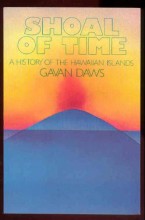
We like Anthony Hooper because he has an obvious desire to spread local literature. He was very excited about recommending a Hawaiiana book and we talked about several titles/authors from Lee Tonouchi to Gavan Daws (whom he knows personally). So for this reading rec we chose to do Shoal of Time by Gavan Daws. I had picked it up and skimmed through it once before, but now I have a good excuse to read it and will post a review in the future!
 

Thank you so much to Anthony Hooper and the staff at Wahiawa Public Library for speaking with us. I think the Wahiawa Library is charming and like Goldilocks said, “not too big, not too small, but just right!” because indeed it is.

Library Tour: Hawaii Kai Public Library

Hawaii Kai is far. Not really…but it sure seems that way.  With the two of us being more West Side than East, going to Hawaii Kai is somewhat of a treat…or at least a rare occurrence.  We like the different vibe: the wide open proximity to the ocean, the touch of affluence, the proliferation of residential docks and boats, the ominous Koko Head crater and Koko Marina Shopping Center.  Even the air smells a little different.  And anytime we’re in the area we always end up driving around deciding which unique restaurant to try.  Now, we can add the Hawaii Kai Library to our list of interesting places in Hawaii Kai to visit.

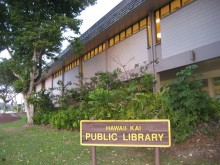
The library is located across the street from Koko Marina Shopping Center on the Lunalilo Home Road side. When we pulled into the structure, one of the pleasant surprises we had was the covered parking.  I think McCully-Moiliili Public Library is the only other library on Oahu to have this feature—so it really is a nice luxury, especially if it happens to be pouring rain (see Waikiki-Kapahulu).

The Building

“This building is a little over thirty years old,” explained Branch Manager Colleen Lashway, and it’s not without its history and perks (see “The Haunting” paragraph below). There is also a strong community vibe that permeates throughout the library. There are a number of local organizations from Hawaii Kai who use the library as a place to meet.

At first we were curious about the obvious influence of Japanese art and history in the library’s décor. Big sakana windsocks hang from the ceiling, Japanese paintings adorn the walls, and Japanese dolls and other artifacts are on display in glass cases. One organization, the Hawaii Kai Lions, contributes much to the library in the form of gifts, monetary donations, building painting and yard cleaning. Colleen mentioned that “there is a long ongoing Hawaii Kai Lions friendship with Nagoya, Japan that spans 22 years.” The two groups jointly make annual donations to the library and in 2007 they donated gifts including a samurai face mask.1

The large meeting room downstairs.

One reason community groups feel so at home at Hawaii Kai Library is their awesome meeting room. When you enter from the parking lot, you find yourself in an enormous room which also doubles as the donation area.  When we were there, there were benches along the wall and tons (I mean, TONS) of boxes full of books; we had really seen nothing like it before.  It’s a very unique and useful space for Hawaii Kai to have—Colleen says the space is used by many organizations and can be rented out for presentations. It was even used by the Hawaii Blood Bank (our fellow HBB) when the bloodmobile broke down.

Everything else is on the second floor—and is accessible by stairs or elevator.  Immediately upstairs is a little loft that houses the restrooms, free magazines, videos and four shelves of books on sale. The library itself is one large, continuous room with no walls or dividers—one big cavernous space.  Perfect for yelling—if that was your thing, but I would recommend keeping quiet. Of course, having one large space can make it hard to separate things, but the staff here have done a great job using shelves and prominent signage to distinguish the separate areas.

The Collection

From the entrance, immediately to your left is the children’s and juvenile section. Decorated with a cute play area full of children’s seating, stuffed animals and toys, it’s a cute, organized area boundaried off by different carpeting. They even separate the “Hawaiian Easy” books and picture books from the rest. Another thing Misty and I like are the convenient plastic pockets hanging from the bookshelves that contain readily available book lists for kids to peruse on a wide variety of subjects and categories.

Inside Hawaii Kai Library. Note the sakana on the ceiling.

Towards the back, one of the most prominent sections is the Mystery/ Suspense section. There are 4  low level book cases entirely dedicated and crammed full of books in that genre! Colleen summed up the community’s tastes by telling us, “[Hawaii Kai Library’s] customers love to curl up with crime.”  They do a good job of dividing up the fiction, as they have prominent areas for Mystery, Sci-Fi, Western and even a Romance Center. The library also has a decent Hawaiian reference section with various material including cabinets of Hawaiian pamphlets, picture files, State documents and old Honolulu Advertisers.

Many libraries have honorback books, but Hawaii Kai has honorbacks for foreign books!  If you don’t know, honorbacks are books from the library that you can borrow without checking out.  Basically it’s an honor system for you to return the book—otherwise they have no formal means of tracking it.  A lot of this freedom is due to the amount of foreign book donations they receive.  It takes time and room to do cataloguing for new books so they often mark the surplus as honorbacks.  Of course, they will purchase popular foreign books such as those in the Harry Potter series due to high demand.

The Programs

Hawaii Kai has a number of programs throughout the year and is very oriented towards the community’s tastes.  A few of the interesting things they’ve had in their past: Bishop Museum holding a presentation on insects, Alton Chung telling ghost stories, the Pickle Lady demonstrating her cooking, and much more.  Back in November they even held a big celebration for National Gaming Day—complete with board games for people of all ages to play.  How fun is that?  Regularly, they have a big book sale twice a year.  Also, they try to have a weekly storytime and every first Thursday a story puzzle time where kids get to play with puzzles.

The Challenges

Like all libraries, Hawaii Kai’s biggest challenge is budget cuts.  Recently one staff member retired, and with a hiring freeze in effect for a long time, it’s hard to get the funding or approval to hire more staff. Donations are always welcome, and you can easily leave a box full of books in the big meeting room downstairs. We happened to have a box we’ve been meaning to turn in, so we conveniently left it there for the library.

The Haunting

The famous haunted elevator.

Every time we interview a librarian and ask if the place is haunted we almost always get a “no” answer.  However, Hawaii Kai Library is different! Colleen herself wasn’t sure as she has only worked there for three years, but she asked some of the long-time staff and they had a story to tell. Apparently, there have been accounts from various staff members about the Hawaii Kai Library elevator being haunted. It was always after hours when the elevator would be locked.  The accounts state that even though nobody was around, the elevator would start moving on its own.  It would open, make a dinging sound, and then drop to the first floor.  A skeptical explanation given was that it may have been bugs or insects that covered the elevator’s sensors…however, we were excited to finally find something and are happy to share with everyone the story of Hawaii Kai Library’s haunted elevator. The funny thing is, after our visit here other librarians from different branches confirmed hearing the story of the haunted elevator. Even a few who used to work here that transferred branches would recount their experiences with it.

Book Recommendation

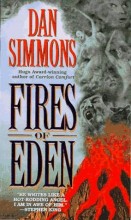
When we got to the question of a book recommendation, Colleen’s eyes lit up and she began to talk about a number of books she was interested in.  We were discussing Hawaii books that would appeal to a wide audience and possibly make an impact elsewhere.  She said, it’s “hard to find one book everyone will like!”  She did say she enjoyed certain books with a darker tone and that she really likes Lois Ann Yamanaka.  After further contemplation she thought of a horror novel by Dan Simmons called Fires of Eden, a novel about bad things happening at resort, but with a Hawaiian curse-kinda twist.  Or so I surmised from Amazon.  I look forward to it.  Colleen also gave us a few non-Hawaiiana book recs such as Big Island and the The Ghosts of Belfast.
I would like to take this opportunity to give a big thank you to Colleen and the friendly staff at Hawaii Kai Library.  It was most interesting to know of the famed haunted elevator!  Hope everyone is enjoying National Library Week and we will continue with another library tomorrow.

The library itself is one, gigantic, enormous room with no walls or dividers—one big cavernous space.  Perfect for yelling!

Colleen Lashway

Collection

One of the more prominent sections that we noticed was the Mystery shelves of books towards the back.

Every time we interview a librarian and talk about any spectral activity within that library, we almost always get an answer of “no.”  However, Hawaii Kai Library provided the most impressive answer to the question, “Is the library haunted?”  Instead of the typical

Book Recommendation

When we got to the question of a book recommendation, Colleen’s eyes lit up and she began to talk about a number of books she was interested in.  We were discussing Hawaii books that would appeal to a wide audience and possibly make an impact elsewhere.  She said, it’s “hard to find one book everyone will like!”  She did say she enjoyed certain books with a darker tone and that she really likes Lois Ann Yamanaka.  After further contemplation she thought of a horror novel by Dan Simmons called Fires of Eden, a novel about bad things happening at resort, but with a Hawaiian curse-kinda twist.  Or so I surmised from Amazon.  I look forward to it.  Colleen also gave us a few non-Hawaiiana book recs such as Big Island and the The Ghosts of Belfast.

I would like to take this opportunity to give a big thank you to Colleen and the friendly staff at Hawaii Kai Library. I hope everyone is enjoying National Library Week and we will continue our week-long celebration by featuring another Hawaii library tomorrow.


1 Nagoya Joto Lions Club Donation to Library

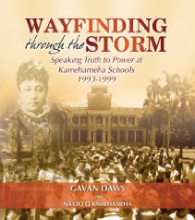
Book Review- Wayfinding Through the Storm

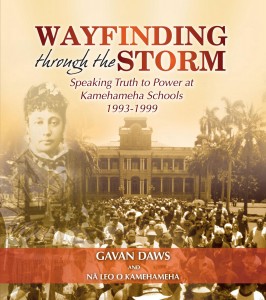
One of the books recommended to us by Manoa Library Branch Manager Christel Collins, as part of our Library Tour Challenge, is the latest historic composition of Gavan Daws. Wayfinding Through the Storm (Watermark, 2009) is one of the most unique books I’ve ever read.  With the subtitle “Speaking Truth to Power at Kamehameha Schools 1993-1999”, Wayfinding Through the Storm is a compilation of 150 individual accounts of the controversy surrounding Kamehameha Schools Bishop Estate (KSBE) Trustees during the greater part of the 90’s. It was a dark time, when Pauahi’s benevolent legacy was thrust into the national limelight. The voices and perspectives of the people who lived through those tense years, seamlessly and meticulously organized by Daws, convey the events that made up the saddest decade in the history of Kamehameha Schools.

It’s an extraordinary piece of non-fiction because the basic story of what went down is being told by 150 people, records and court transcripts, as if it were one narrative. It takes a little while to get used to the idea that you’re reading separate pieces of dialogue one after the other; they somehow all make sense, and you can follow what everyone is saying as if the story were being told to you by one person. It’s unlike any work of history I’ve read before and I think it’s genius! Imagine asking 150 people to tell you the same story… then taking what everyone says, mashing it together and telling the story again. What a way to learn history!

The book itself is broken up into chapters, each one detailing how the expansion of education, language and cultural exchange were suffocated by the imbalance and abuse of power between KSBE Trustees. Although I am not an alumnus of Kamehameha, I was still interested in reading about what happened through the words of the people who experienced it. Reading about the progressive ideas of the Kamehameha faculty and staff, and the hard work they put into bringing these ideas into fruition for the benefit of Hawaiians, our children, our kupuna and our future (extended education programs, a Hawaiian cultural center, expanded language programs)–only to have those opportunities squandered and those ideas squashed by self-interested oppressors, was truly saddening. It’s like watching the movie “Glory”… that feeling you get when you see people being treated unfairly. I had to constantly keep from shouting “but that’s not fair! (and yes, the word “meanie” was mentioned several times on my behalf in regard to Lokelani Lindsey). Yet, the book is still hopeful of the future because it was an important lesson learned. Beadie Dawson’s quote on the back of the book summarizes it perfectly, “absolute power corrupts absolutely.”

This book is an inspiration. First obviously, in that we should always question totalitarian ideals, second, that people can unite and be heard, and third, that history can be learned and told in interesting ways. Wayfinding should be read by everyone, not just people with an interest in KSBE or Hawaiian history. It may seem like a niche subject but the theme is universal and I have to take this moment to congratulate the publishers at Watermark. They continuously produce well-made, provocative books. Not just those that are guaranteed to sell, with proven markets based on current trends or because tourists will buy them… but because they’re important stories that deserve to be told.

Library Tour: Kaneohe Public Library

HBLC09 Kaneohe

Libraries are often very busy on Saturdays and not all branches have the luxury of being open on a weekend, so we try to visit most locations during the week.  One of the challenges we have in our Library Tour is traveling by car from the Honolulu Airport area (where we both work full-time) to each of the different branches on the island.  We decided that it would be best to focus on the libraries that are farthest from us, first and it is with great pleasure that we conclude our tour of the Windward side with a visit to Kaneohe Public Library—the largest of the four Windward libraries on O’ahu.

Kaneohe Library is distinctively situated against a hill behind the Kaneohe Police Station.  The parking entrance isn’t off the main road so it’s easy to miss, but if you turn just before Benjamin Parker Elementary you’ll see the library’s driveway.  This being my first time at this branch, I had a little confusion at first on where to park as I initially stumbled into the police station.  For library patrons there is handicap parking located on the second level between the library and the station, but for the general public, the lot is found at the end of the driveway at the bottom of the hill where there are ample stalls!

Kaneohe Library

Building

The building is two stories and the structure itself is built right into the hillside. It looks like the houses built in the valleys, complete with red dirt and stilts, and already you get a feel for its personality. Immediately from the parking lot you will see the impressive space allocated for the Friends of Kaneohe Library book store.  It was reminiscent of the book store we saw at Kailua Public Library, however much larger–two big rooms full of books for sale!  Outside the door there were carts full of books that were free for the taking.  While I didn’t see anything that piqued my interest, they had a nice selection of hardcover books available and overall the biggest selection of free books offered by any Friends of the Library Chapter.

Paul Nash muralOn the upper level lanai, just outside the main entrance, there is a lovely painted tile mural entitled “The Ko’olau Mountains” which was a gift by the Friends of the Library of Hawaii and Windward Community College.  The mural was designed by Paul L. Nash and was completed by a host of student artists in 1985.  Once inside you are treated to a very large lobby area with bulletin boards featuring community events, children’s services, government news and other relevant neighborhood info.  But most interestingly we saw a special “Library Card Application” table, a designated space with pens and applications and all manner of brochures providing information on how to sign up and the benefits of participating in the library system. There’s no doubt the staff at Kaneohe library are excited about getting people signed up and involved!
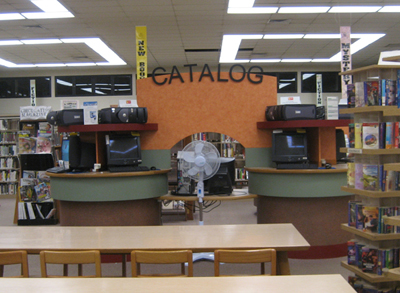
The library area itself is a wide open rectangular space, divided up primarily by bookshelves.  Immediately to the left is a nice Teen/Young Adult section that is enclosed by shelves full of YA and sci-fi/fantasy books.  In this small section alone there were a number of tables and chairs readily available for seating.  Aside from the usual manga, Kaneohe Library has a nice collection of graphic novels (yes, there’s a difference), and I made use of this by borrowing a few of their comics during our visit.  For anyone interested, I finally read Brad Meltzer’s Identity Crisis and thoroughly enjoyed its unique look at the DC superheroes.  In addition to the comics, they even had a small YA Hawaiiana fiction section (we like when Hawaiiana books get separated for more exposure), although some of the titles they included seemed to be reaching a bit as they either straddled more juvenile or adult pursuits.

Custom Catalog StationOne of the most noticeable aspects inside the library is the furniture. It’s very unique. The one that sticks out the most is the custom designed catalog station, which houses the computer terminals to access the online library catalog.  Some of the library’s shelving and the reference desk is also customized to match. With sleek lines and a fairly modern design it adds a lot of interest and functionality to the space. Branch Manager, Thomas Churma, told us that the acquisition of the furniture had a lot to do with the “bang up business” done by the Friends of Library Kaneohe.  Not too long ago they added twelve more reading carols in the back of the library, providing patrons with a nice quiet area with extra privacy.  So naturally, Thomas made sure to shill the book store downstairs by mentioning that they have “the best prices on the island!”  And after seeing the immense collection of books they have for sale for such discounted prices, I would recommend anyone interested in books to check it out if you’re in the Windward area.
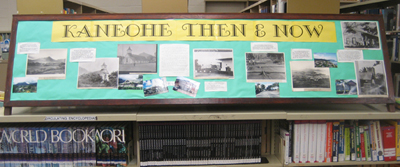
Another noticeable trait is the sense of pride and history you feel for the Kaneohe community.  And the more we walked around and spoke with Thomas, the more this became a theme of Kaneohe Library.  Displayed atop the low book shelves as you enter are huge, black & white panoramic photographs of old Kaneohe.  Along the short reference shelves near the children’s section a nice “Then & Now” display is featured, showing the contrast between old and modern Kaneohe.  They have an impressive Hawaiiana section which not only houses all of the new books, but also an intriguing collection of older, out-of-print books that are still in great condition. Hawaiiana books are notorious for having short publishing lives and the fact that Kaneohe Library takes great care in keeping out-of-print books available speaks highly of them. Thomas also told us that they have a lot of historical photographs of Kaneohe—in fact, they have four binders full of them, more than any other collection. If there’s ever some extra money, one of Thomas’ goals and a goal of the library is to digitize these photos as well as a few of the older Kaneohe history books.

Kaneohe, Then & Now

Programs

Kaneohe Library offers many of the traditional library services that others offer.  Like many of the libraries we have visited, the most popular of these services are the Internet stations.  Kaneohe has seven ‘One-hour’ Internet terminals for use along with one 15-minute express station.  In addition to the standard hard-wired Internet access, Kaneohe Library is one of two libraries in the State that offers free wi-fi access.  This modern amenity gives patrons the freedom to bring their own laptops and do online research from the comfort of their own computer.

One of the areas where Kaneohe shines in terms of programs is with the children.  They have a “First Wednesday” program at the beginning of every month which includes a preschool activity night with oogles n googles which is very popular, often bringing 50 to 75 people in attendance.  They want to encourage families with young children to spend quality time reading, playing and socializing together with performances that are interactive, imaginative, and lots of fun.  In addition to that, Kaneohe Library has two separate story time for toddlers (Thursdays) and preschool children (Tuesdays), providing different levels of fun and education to the keiki of Kaneohe. Thomas said they try their best to accomodate the interests of all their patrons, and having age appropriate storytime helps.

They also are trying to bring in more of the Young Adult crowd.  One of the previous events that was featured was a program that featured weaponry, from flint to firearms, with medieval armorer Greywolf.

Challenges & Conclusion

Like most libraries, the biggest challenge facing Kaneohe Library is budget.  Their budget has been cut by a third, which affects a number of things including staffing, programs, and acquisitions.  All in all, Thomas Churma is proud of Kaneohe and is appreciative of the community.  He says the people in Kaneohe are very relaxed but very supportive as evidenced by their studious Friends of the Kaneohe Library.  They are often in the top 5 or 10 branches in terms of circulation per month and provide the region with a strong Hawaiian and summer reading collection.  Since the early 1960’s they’ve been serving the residents of Kaneohe well… and they have the pictures to prove it! 🙂

The library staff, starting with their management, has a clear devotion for not only sharing the history of the community, but also trying to preserve it.  This is apparent in their book collection, their choice of decor, and the goals they set for themselves.  This is not to say that they are stuck in the past, as they are one of the few libraries to maintain a branch website, incorporate wi-fi, and seek to digitize their local history.  What they provide to Kaneohe is immeasurable in its value.  You can quantify things such as five Internet terminals, or the largest DVD collection, but having a dedicated staff that uses their resources to best preserve the community’s history is a wonderful asset.  The Windward community should continue to support this branch by attending programs, circulating books, CDs and DVDs, and perusing the shelves of the vast Friends of the Library book store.  Don’t forget, they are one of only three libraries to be open on a Sunday!!

“The library is a community center.  It should provide students with a relaxed extension of the classroom.  That’s the way a library should be,” concludes Branch Manager Thomas Churma on our trip to Kaneohe Library.

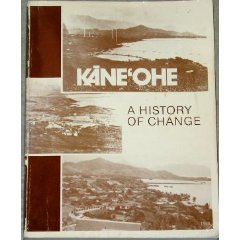
Kaneohe: A History of Change

Book Recommendation

Keeping in line with the appreciation for Kaneohe’s rich history, Thomas Churma recommended that we read Kaneohe: A History of Change; a book published by Bess Press with information compiled by the U.S. Army Corp of Engineers.  We love the idea of finding books in a branch that are specific to the area and I look forward to reading about it and sharing it with you.  It is one of Thomas’ goals to digitize this book especially and make it available to everyone.  Currently they do not have all of the permissions, nor the budgetary resources to accomplish this feat, but hopefully someday they will be able realize this ambition.

I want to thank Kaneohe Library and Branch Manager Thomas Churma for taking the time to talk with us about the library and supply us with such informative things to share.  To celebrate, Misty and I drove down to Windward Mall and had some delectable grinds at Hot Dog on a Stick.  Hey… it’s the only one on the island, we HAD to go.

Library Tour: Manoa Public Library

HBLC09 Manoa

Coming into this Library Tour Challenge we knew it wouldn’t be easy to accomplish, that there would be some bumps along the way, and that with Hawai’i’s libraries struggling we’d have to be flexible. We knew not all locations would be easy to visit, and that people might not have time to talk to us. In fact, one location would be almost impossible to visit because it no longer existed on its original premises.

When we began this journey, Manoa Public Library had just announced its plans to close its doors and move some of its collection to an interim location in preparation for the construction of a completely new library building slated for completion in 2011. The process of getting Manoa Library ready for its big move began with hundreds of Manoa community members coming out to help move the books out of the soon to be demolished building and into the temporary location at Noelani Elementary. Here’s a nice recap of that event with some great photos of  “Da Book Brigade” carrying bags of books across the street.manolib

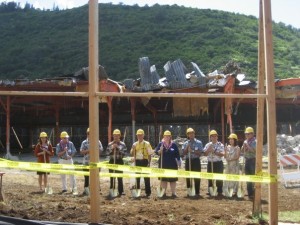
The next big event in the Manoa Public Library moving saga was the ground breaking. Alex and I attended the official ceremony on Saturday, October 17th in the parking lot of the old library. You could still see the steel frame beams standing forlorn amid the rubble, but it was a sunny day and tons of people came out to celebrate and remember the old Manoa Library as well as join in on the blessing for the building of a newer, “greener” one. The old building’s steel frame will be recycled and reused and the new building will be constructed with energy efficient, eco-friendly materials. Several people spoke and the ceremony as a whole was positive and hopeful. Here’s  a video link we shot of Kahu Mahealani Wong blessing the construction site.

Manoa Library ground breaking & blessing

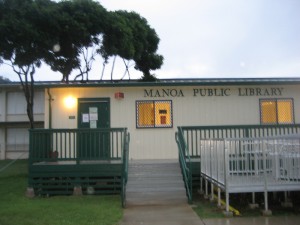
After seeing the bared remains of the Manoa Public Library and examining the plans for the new building, I knew this library tour/interview would be different from the others we’d already done. So,  Alex and I drove back to Manoa on a rainy evening to finally meet Branch Manager Christel Collins in the portables of their temporary location. There’s plenty of parking in front of Noelani Elementary and a sign just off the front gate lets you know that the Manoa Public Library has made the school it’s temporary home. There isn’t  much space inside but the staff did manage to squeeze in a couple of terminals for internet use, a small table to peruse the DVD/CD collection and enough shelves to hold a respectable selection of books in every genre. They offer the same services as usual but due to special hours and lack of space, their storytime programs are on hiatus. Christel joked at how they’ve become more of an “Express Library” and recalled how hard it was to move into such small quarters. “It was agonizing making the decision for what books to bring and what books to leave in storage. The Childrens’ Librarian had to decide ‘this book, or this book?!’.” manoa05

Usually we ask about the building itself in each location because we want to know about its history or if there’s anything unique about it architecturally. That was one question we would have to rephrase, and instead we asked Christel what she was most excited about for the new library. Among the new library’s features, Christel said she’s looking forward to the additional square footage. There will nearly be “twice the space for children, and more space for the staff in back which allows us to move materials out faster…that means better service for patrons. And the parking area will be twice as big!”.

During the blessing ceremony, the new library architect and building contractor got up to say a few words and they mentioned that Christel and the staff at Manoa Library had a lot of input into what would go into the new building. Christel elaborated that the staff suggested things like having a drive up book drop, and two different kinds of drops, one for fragile materials so that patrons can quickly return DVD’s and CD’s at their convenience.

Many were also concerned about the look of the new library. They wanted it to set an example for other “green” library renovations, but also wanted it to be a reflection of the community, instead of a big box building that overwhelms it. “The rock  in the rock walls will be the same as it was in the old library and the sloped roof will give it a residential look”.Manoamemories

“We were fortunate enough to secure the funds for this rebuild before the current financial crisis hit. We really needed it. You have to consider what the community was like when the original library was built. Manoa was different, it was a rural community with pastures… years later the library was just too small and overstuffed to meet the needs of the growing area.”

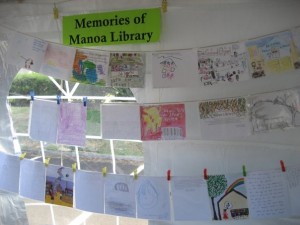
As part of the Manoa Library groundbreaking ceremony there were illustrations and handwritten notes from people and children in the neighborhood. They called them Memories of Manoa Library. “My favorite was from an older lady and a long-time patron who remembers visiting the library as a child and bringing apples and carrots with her to feed the horses nearby.” Here’s a nice blog article in the Honolulu Advertiser by Manoa resident Kristen Brummel about more “Manoa Memories” of the library.

“If the budget crisis doesn’t improve our real challenge will be how to buy new materials for the library when it reopens in 2011.” They would face problems similar to those experienced by Kapolei Library when it first opened. But Christel is optimistic about everything and is proud that they’ve already started their eco-friendly operations. She was able to keep a lot of the old furniture for use in non-public areas of the new library. This way they’ll have to spend less to furnish it.

The immediate challenges are mostly lack of space, shorter hours and staffing. The Manoa Public Library Childrens’ Librarian and one other staff member are constantly deployed to other locations to help out libraries who are short staffed. “They’re essentially doing two jobs.. double duty,” Christel explained. Right now the Manoa Public Library has a unique schedule of operations, check here for the official hours. The shorter hours are due to an agreement with Noelani Elementary to limit public disturbances during the school day.

Whatever the challenge, now or in the future, we have no doubt that the new library will be a success as long as positive and passionate people like Christel and her staff are around to see it through. Despite being cramped like sardines, having their materials stored in different places across the island, and their staff scattered about working double duty, they’re taking it all with a grain of salt and still smiling. Most of all they’re just excited about the opportunities the new library will provide for the community and its residents. They’re enthusiasm is quite contagious… I’m sure Alex and I will be one of the first to happily visit the new library when it’s done.

Thank you to Branch Manager Christel Collins and the staff at Manoa Public Library for allowing us to visit and talk! After our meeting with Christel we were gonna eat at Serg’s Mexican Kitchen on Manoa Road but it was pouring rain and we ended up at a cozy yakiniku place instead. Yummy! 😉

Christel Collins Hawaiiana Book Recommendation:

kambookChristel suggested we read Wayfinding Through the Storm (Watermark Publishing) by famous author and historian Gavan Daws. Although we talked about many interesting local books (Christel agrees with our passionate assertions that Hawaii has a unique literary community) she picked this book because Mr. Daws is a regular patron of Manoa Library and resident of the area. Stay tuned for a review!

Library Tour: Waimānalo Public and School Library

posted by D.Sueoka

HBLC09 Waimanalo

A few Wednesdays ago, Misty, Alex, and I made the trek over the Pali to visit the Waimānalo Public and School Library. The library is located at 41-1320 Kalaniana‘ole Highway. Stately banyan trees shelter the entrance and parking lot, and there’s a spectacular view of the Ko‘olau Mountains.

waimanalo mural

The Building

One of the first things we noticed was the beautiful mural near the entrance to the building. Painted by artist (and cowboy!) Patrick Ching (www.patrickchingart.com), it depicts real members of the Waimānalo community. Stepping into the building, we were happy to see a community bulletin board, pamphlets and newsletters for local organizations, a large stack of outdoors-y magazines (free for the taking), and a display entitled “Be Creative” that featured art made from pipe cleaners, foam, egg cartons and corks; and collages done by preschoolers.

Lisa Elson-Young welcomed us to the library and showed us around. On the wall behind the circulation desk were framed photographs of Waimānalo that were published in a National Geographic magazine feature. She also pointed out a 3-D mural, funded by a Friends of the Library grant and painted by Tara Sullivan, in the children’s section of the library. Its ‘iwa birds, honu, nai‘a, monk seals, and playing children really brighten up the area. During preschool storytime (every Thursday at 10:15), there’s even a special jungle rug–complete with jungle path–for children to sit and play (and of course listen) on.

waimanalo mural2

Though the library’s collection is small, Lisa reminded us that patrons are not limited to materials housed in the building. They can request books, CDs, and DVDs from any library in the state.

The library’s meeting room is available for state and city agencies, non-profits, and for-profit companies to rent.

Finally, we were all very relieved to hear Lisa say that, as far as she knew, the library was not haunted.

Programs:

The library’s main public program is preschool craft and storytime at 10:15 every Thursday. During the summer, the library hosts more nighttime programs, but during the school year, it is limited by its small budget. Lisa said she would especially like to reach out to young adult and reluctant readers.

Like Hawai‘i’s other libraries, the Waimānalo library lacks funding to put on as many programs as they would like and to stay open as long as they would like. A Verizon grant once paid the electricity bill on the weekends, but now, the library can only stay open from 10 to 2 on Saturday. If only one of the 3.5 employees is present, the library is forced to close for safety reasons.

Lisa explained that the Waimānalo community, which includes the very rich and very poor, is strong, supportive, and mellow. The library offers computers with internet access, hosts adult literacy and computer classes through the Windward School for Adults, and has one of the best Hawaiian CD collections in the system.

One of the great things about being a community and school library, Lisa said, is that the librarians can watch the children grow up and bring their own children to the library. She remembered one student in particular, who visited the library as an elementary school student, worked as a student helper in the library while attending Kailua High School, and is now in the nursing program at HPU!

A benefit of being a small library, she added, is that each staff member gets to perform many different roles—something that doesn’t happen in larger, more compartmentalized libraries. Although this means that they are sometimes overwhelmed by paperwork, it also means that everyone gets to interact with the public—whether at the circulation desk, at the reference desk, or through the library’s programs. “We’re there for people to get what they want or need,” Lisa said. “I love it.”

waimanalo circulation

Lisa Elson-Young’s Hawaiiana Recommendations:

kaitheopihiLisa recommended Kai the ‘Opihi Gets the Point (reviewed October 21) because of its great illustrations—something we’d like to see even more of in local children’s books. She was lucky enough to meet the authors and illustrator at a recent Read to Me conference, and reported that they were great. The book was written through a grant from the Tūtū and Me program (www.tutuandme.org), which helps prepare disadvantaged children to enter school. “It’s about self-esteem,” Lisa said, “and it’s very positive for kids.”

Her second recommendation was Hawaii: The Electric Century, a coffee table book that drew many oohs and ahhs from the HBB crew. Commissioned by the Hawaiian Electric Company, it compares historical photographs from the Bishop Museum Archives to their modern-day counterparts. Lisa’s work in the museum’s photo archives helped her appreciate this book even more. When you look at each pair of photos, the changes “really hit you,” she said.

Many thanks to Lisa and the Waimānalo Public Library staff for a wonderful evening (which Misty, Alex, and I rounded off with Portuguese sausage omelets from the Dillingham Zippy’s)!