Pass On, No Pass Back!
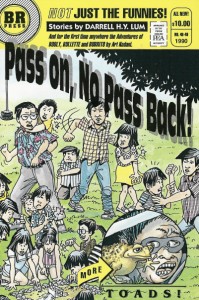
Pass On, No Pass Back! is the award-winning collection of nine short stories by local author Darrell H.Y. Lum. Lum is well known for providing a prominent voice to the art of Hawaii’s Pidgin English storytelling, and most of the short stories in this book are told in this narrative style. Pass On, No Pass Back! was originally published in 1990 by Bamboo Ridge Press, the local book publishing company co-founded by Darrell Lum in 1978. I was lucky enough to pick up an autographed copy recently from Mr. Lum at the Hawaiian Book & Music Festival–and consider it a cherished part of my book collection.
Darrell Lum writes about what it is like to live and grow up locally in Hawaii. Many of these stories take you back to a simpler time in the islands when getting toadshet on your skin gave you warts along with other ooh-gee stuff and five cents worth of kakimochi bought your innocence so long as it was the kind with nori and plenny shoyu on top. Notably, these stories often peel back the skin on many simple attitudes and stereotypes we may have about Hawaii and people in general as Lum mixes the fond familial memories with characters that come from the margins of society. Some of my favorite stories in the book were about characters that embodied these traits such as the Moiliili Bag Man, Coco the graffiti artist and Alfred the junkest classmate. Lum often lent a humanizing perspective to these archetypes, transforming them into real people you can identify with, replete with strengths, flaws and emotions that shape their choices and personalities.
Just how the hippy lady tells Coco that he liberated the wall for everybody, Darrell Lum takes these human portraits that we encounter everyday and liberates them from our own meager generalisations. The archetypes in the book no longer embody the simple, nameless stereotypes that we come to expect, but they have been portrayed with an identifiable human face that you can’t help but identify with. Whether it’s the chicken-skin feeling you get reading about Victor and the sugar cane field, or the immediate sense of claustrophobia settling in when sifting through Zoo’s mind, Darrell Lum is able to capture a feeling in time and bring the reader deep into his stories. And just like Coco, these pages provide Lum’s wall to paint the vibrant colors of his childhood in Hawaii; and even if the face stay crying it is still the nice kine stuff, not the ugly stuff.
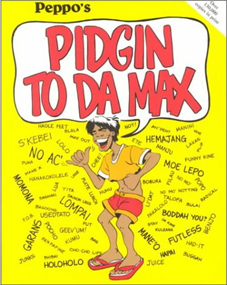 For those of you who may have a tough time understanding local speech, locate a copy of Peppo’s Pidgin to da Max. This is an easy and enjoyable way for the non-local to get immersed into the pidgin experience, yet it also provides a funny reference source for even the longtime local. Of course, no mention of Pidgin to da Max isn’t complete without the famous word of warning to the non-locals that this book is not intended as a lesson in how to speak. You will only get in trouble if you do.
Pidgin to da Max is organized like a descriptive dictionary from which you can alphabetically look up the word you need to find clarification for. However, if you are like most of us, you will enjoy reading this book from cover-to-cover. As a kid, I remember flipping through the pages and laughing at all the humorous illustrations that accompanied a number of definitions; and smiling especially at the way Pidgin phrases would be translated into an almost overtly formal English “translation.” One that reads similarly to the many humorous politically correct translations of common English you may find in a humorous e-mail forward or joke website.
So, for only a $10.00 cover price, Pass On, No Pass Back! is worth picking up for the unique and rich Pidgin narrative on growing up in Hawaii. And unless you stay Pake, get Pidgin to da Max if you don’t have it already!
 A fellow book blogger has issued a challenge for 2009, but since we’re joining the challenge late in the year, HBB will only sign up to read and post about 25 books from the public library. You can see the specifics of the challenge here at
  SAVE the DATE! Buy books and help the underprivileged children of Hawaii.
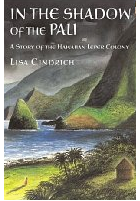 One of the books I picked up at this year’s Friends of the Library of Hawaii booksale was In the Shadow of the Pali: A Story of the Hawaiian Leper Colony by Lisa Cindrich. The synopsis on the back of the book drew me in the way a shiny object mesmerizes a kitten; not only was this a story about the leper colony but it centered around a young pre-adolescent girl taken there against her will after being diagnosed with Hanson’s disease. It dawned on me that there are precious few fictional novels about Kalaupapa and being ever the curious reader, I bought the book immediately. Whatever you know about the history of Kalaupapa or the living and social conditions of the colony will not prepare you for the haunting descriptions in this book.
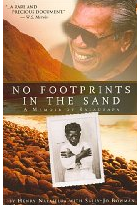 Where Shadow of the Pali was deeply sad and moving, this memoir from Henry Nalaielua is simply inspiring. In Shadow of the Pali we get an idea of the loneliness of being taken to Kalaupapa, but No Footprints in the Sand effectively illustrates just how much Hanson’s disease separated families, ruined lives, and impacted early Hawaiian society. We follow Henry from small kid time, living as a normal kolohe boy watching them take away his sister and later to his own diagnosis and exile, through his life and struggles in Kalaupapa. His story is inspiring because all the horrible situations imagined in the fictional tale of Liliha actually existed for him, and despite them he found love and built a family. Through adversity he created a robust life of happiness for himself, a home where one seemed impossible. It was amazing that he still lived there and passionately called it home. We are lucky to have him share his life story in this book so that future generations never forget the people of Kalaupapa.