
Any historical fiction lovers out there? Which titles do you feel qualify as great, balanced historical fiction?
I very much admire authors like Linda Ballou who choose to write historical fiction. It’s such a tricky genre, constantly treading the line of creative liberty and historical fact. While I appreciate how her numerous travels inspire her to write, and that she was so touched with ancient Hawaiian culture, I have to admit I’ve struggled with reviewing Wai Nani for some time now. Linda is such an enthusiastic author and marketer of her books I couldn’t deny a guest review (check out my counter-review and comments at the end).
Wai-nani: High Chiefess of Hawai’i
A guest review by Barbara Sharp Milbourn
Barbara is a writer and editor living in Nashville.
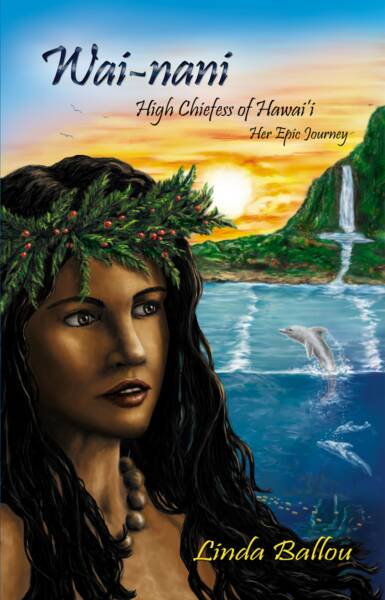 Travel writer and photographer Linda Ballou delivers a generous slice of Hawaiian history with details of land and sea so vivid, it is almost better than being there.
Wai-nani: Voice from Ancient Hawaii is a meticulously researched account of the Hawaiian Islands around the time of Captain James Cook. The major theme of the novel is the dismantling of the social hierarchal system based on kapu (taboo) that had been brought to the Islands by the Tahitians years before. But what a story!
Meet Wai-nani whose character is based on Ka’ahumanu, favorite wife of Kamehameha the Great, unifier of the Hawaiian Islands around 1810. She is a young woman of royal descent so at home in the sea that she thinks of herself as half sea creature. Her comfort in the water is juxtaposed to her conflict on land, particularly her resistance to the kapu system. We accompany her as she leaves home and meets Makaha (Kamehameha) two hundred years ago when chiefs in feathered capes and tattooed warriors battled for island dominion, priests read the future in pig entrails, men and women ate in separate houses, and human sacrifices were commonplace. We know her and her people, and we connect to place through stunning details of mamo birds, koa trees, ‘ie’ie flowers, and taro fields. We drink the bitter ‘awa, trek up steep palis, peer into smoking volcanoes, and wave slide bearded monsters.
Much changed with the arrival of Captain Cook, the death of Kamehameha, and the pressure brought to bear on the system. But some things are eternal—love, the circle of life, and the grand and vibrant sea.
The author’s reverence for the land and its people inhabits her words. Linda Ballou is a new voice from ancient Hawaii.
___________________
To say that Linda did extensive research for this book would be an understatement. You can tell she put in great effort to make Wai Nani culturally reflective. Maybe too much. It’s like when you’ve just learned a list of new vocabulary words and crammed them all into a paragraph. It’s great that you know and use them but not necessarily the best or most natural reading/narrative. The story, although excellent in setting, was lacking in subtlety. I felt like I was repeatedly being hit over the head with things to make me sympathize with Wai Nani. We see Wai Nani rebelling and then she tells us she’s rebelling. Then she reflects on how guilty she feels for rebelling, and then she gets her dolphin friends to help her rebel some more, against the SO oppressive kapu system that basically kept people working the land with great harvests and a structured society for hundreds of years, but we have no real idea why.
Also the switching between third and first person now and then was confusing… it seemed Wai Nani could read all manner of people’s (and animals’) minds and feelings.
Linda does wonders in describing the land and the sea—how the people were tied to it, how important it was to their lives and spirits. However, the overly sensualized dolphin encounters were a bit over the top for me… Wai Nani feels at one with the sea, I get it. I appreciate that the author didn’t hold back in depicting how open the Hawaiians were with their sexuality but some of the scenes were so romanticised it was borderline saccharine. The problem I had with this book—other than its basis on Kaahumanu as some kind of feminist liberator with mystical connections to the sea, land and gods— is that the story would be going well and then it would just warp into “too much everything”.
Initially after reading this book I was ready to write a full length academic essay on historical fiction and cultural representation. I really struggled with it because ultimately I’m glad that people are writing fiction about Hawaii and its people, and I know that even if the book is not to my taste, someone will enjoy it and it will inspire them, and hopefully get them interested in reading more about our islands.
I both agree and disagree with the guest review.”The author’s reverence for the land and its people” DOES inhabit her words, and she certainly succeeds in painting a beautiful picture while showcasing the very spiritual, nature-loving side of the Hawaiian people. But as the reviewer says “Linda Ballou is a new voice from ancient Hawaii”, well, that’s a big statement that scares me a little bit a lot.
Visit Linda’s author page and read more about her books and adventures. You can also purchase the book and read sample excerpts. Thank you to Linda for kindly sending us a copy and for graciously reminding us to review the book. We wish you many more great adventures and successful stories. Thank you to Barbara for her guest review.
Thank you for taking the time to write a review of my work even though you had problems with the book. I knew that when I published Wai-nani, I would be pleasing some of the people some of the time, but knew I could not to please all of the people all of the time,especially Hawaiians who are not fond of haoles writing about thier history. I appreciate that you sandwiched critisms between compliments.
I am presently working on a map “Walk with Wai-nani in the Footsteps of the Ancestors” that will assist modern readers in finding and understanding the significance of the historical sites found throughout the Islands, especially on the Big Island.
Malaho Nui for your time and thoughts. I will take them into consideration in future efforts.
Linda
Linda, thank you for your comment. We always appreciate discussion and participation on HBB. I found your response interesting and exemplary of what I meant in the review by ‘too much everything’.
You could have stopped there and I would have totally agreed with you. It’s tough being an author and having your work out there with everyone reacting differently as they will.
And that’s about where I wondered why I was still reading. Honestly, if you had been Native Hawaiian I probably would have liked the book even less. You won’t please people, regardless of race, if your story is slow and your main character is contradictory and shallow.
Will there be “Hawaiians” who dismiss Wai Nani simply because the author is “haole”, probably. But those are the people who would be least helped by reading it anyway. The truth of the matter is, that so much of Hawaii’s cultural history, language and myth have been preserved because of the talent and hard work of Western/haole authors—Westervelt, Daws, Stevenson, Emerson. Anyone who takes issue with haole authors writing Hawaiian history should be educated otherwise. Would I use Wai Nani as an example to educate them? Not likely. It’s a work of historical fiction, meant to be read for enjoyment and therefore allowed it’s frivolities, saying it will get bad reviews by Hawaiians who don’t like haoles is just giving it undue credit.
I think you misunderstood my comment. I have had good reviews from Hawaiians and westerners alike. I just was trying to say that I understand that not everyone will like what I have tried to do. My story is fabled history couched in magical realism. Wai-nani’s mythological journey is one that takes her to self-discovery and empowerment. She is not intended to be a literal representation of Ka’ahumanu. She was simply inspired by this powerful personage that played a large role a colorful history I felt had been overlooked.
I have found women more willing to take the ride than men. I am not making a statment against men when I say this. It is simply a fact.
So, once again, thank you for taking the time to read a book you did not enjoy. I know how hard it is to write a review for a book that does not engage me. So, let there be no misunderstanding, I did not say you objected to Wai-nani, because you are Hawaiian, I said I understand that my work will not please everyone, no matter how hard I try.
Shall we be friends?
Linda
Of course we shall be friends! I wasn’t insulted by your comment so much as shocked that you felt it necessary to include. I also realize Wai Nani wasn’t meant to be a literal representation, that much was obvious. I meant it when I said I appreciate your hard work in writing stories about Hawaii and even though I’m not a fan of Wai Nani the character (even if she wasn’t at all associated with Kaahumanu), I still think your next project with Wai Nani on the Big Island is interesting and will look forward to it.
Great! Thanks. One of the extremne pleasures for me in researching for this story was visiting as many of the places described in history books as I could. I think sharing these sites with readers in the form of a map will be a wonderful way to enhance the experience of visitors to the Islands. AS you know Kaleakakua Bay, where Captain Cook was killed, is a wonderful place to snorkel and dolphin still come there to rest after a night of fishing in the deep waters. However, I do have a question for you? When I looked up the Naha Stone that Kamehameha lifted when he was a youth in Hilo, it was completely unheralded. One would never find it, or know it’s significane if they didn’t know what you were looking for. Is this because Hawaiians would prefer it be to left off the tourist track, or is this because moderns are busy with thier own lives and it has been forgotten?
I would appreciate your input on this subject.
Mahalo
Linda
That’s a good question! I wouldn’t mind knowing the answer to myself as I have often wondered why the Naha stone is not at least sheltered from the elements in some way. I think it’s great that it has a place of honor in front of the Hilo library and that there’s a little plaque about it, but why it hasn’t been made more of an attraction I do not know. It is a very interesting question, especially since the story of the Naha stone is significant to Kamehameha’s rise to power.
Thanks for getting back. I will include it on the map and hope that I am not offending anyone by doing so. I think Wai-nani readers will find it of great interest.
Mahalo,
Linda